
How to Choose the Right Crawl Space Dehumidifier Size
Choosing the right crawl space dehumidifier size is not as simple as matching one number to square footage. Square footage matters, but so do humidity level, encapsulation status, drainage, climate, crawl space height, and airflow.
Every encapsulated crawl space needs some form of mechanical drying. Most homeowners solve that with a crawl space dehumidifier, while some systems use supply air inducers or another approved drying method. The point is that sealing the crawl space is only part of the moisture-control system.
A dry, encapsulated 1,200 square foot crawl space may not need the same dehumidifier as a damp 1,200 square foot crawl space with open vents and sweating ductwork. The right size depends on the moisture load, not just the floor area.
This guide gives you a practical way to think through sizing before you buy.
Short Answer
Start with square footage, then adjust for the crawl space conditions.
| Crawl Space Condition | Typical Direction |
|---|---|
| Small, clean, encapsulated crawl space | Compact 50 pint or 70 pint class may be enough |
| Average encapsulated crawl space | 70 to 75 pint class is often the starting point |
| Larger crawl space or humid climate | Consider 80 to 100 pint class or comparable high-capacity units |
| Not fully encapsulated | Seal the crawl space first, then size the unit |
| Standing water or drainage problems | Fix water entry before relying on dehumidification |
| Long, divided, or obstructed layout | Airflow, ducting, placement, or two units may matter as much as capacity |
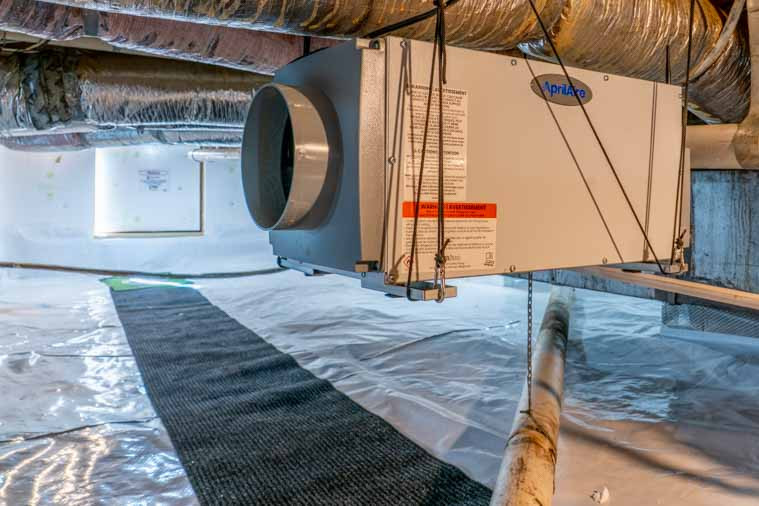
For many homeowners, practical examples include the AprilAire E070, Santa Fe Compact70, and Mega-Dry CS75. Smaller crawl spaces may also justify a compact 50 pint unit such as the AprilAire E050, while larger or more complicated crawl spaces may need a higher-capacity model. The best choice depends on clearance, layout, controls, and moisture load.
Why Crawl Spaces Are Different From Rooms
A household room has finished floors, open air movement, normal ceiling height, and easier access. A crawl space is different.
Crawl spaces often have:
- Low clearance
- Exposed soil or a vapor barrier over soil
- Foundation walls that can hold moisture
- HVAC ducts, plumbing, and wiring
- Uneven airflow from one end to the other
- Seasonal humidity swings
- Limited access for service and drainage
That is why a crawl space dehumidifier should be built for crawl space conditions. A regular household dehumidifier may not fit well, drain well, or hold up well in a low clearance environment.
Step 1: Start With Square Footage
Square footage is the first filter. Measure the length and width of the crawl space and multiply them together. If the crawl space is broken into sections, measure each section and add them together.
Use this as a rough starting point:
| Crawl Space Size | Starting Point |
|---|---|
| Under 1,000 sq ft | Compact 50 pint or 70 pint crawl space dehumidifier, depending on humidity and clearance |
| 1,000 to 2,200 sq ft | 70 to 75 pint class is often a practical starting point |
| 2,200 to 2,600 sq ft | 70 to 80 pint class may work, depending on moisture load and layout |
| 2,600 to 3,200 sq ft | 100 pint class or comparable high-capacity unit is often worth considering |
| Over 3,200 sq ft | Larger capacity, two dehumidifiers, multiple airflow zones, or ducting may be needed |
These are planning ranges, not guarantees. Also compare the manufacturer's stated crawl space coverage for the specific model you are considering. Two 70 pint dehumidifiers may not move the same amount of air or cover the same square footage because blower strength, cabinet design, efficiency, and other factors vary by model.
Step 2: Adjust for Moisture Load
Moisture load is the amount of water the drying system has to handle after the major moisture sources are addressed. Before assuming you need a larger dehumidifier, make sure the crawl space plan includes proper encapsulation, sealed vents, and drainage correction where needed.
Consider more capacity, better air distribution, or a different drying approach when there are conditions such as:
- A crawl space that will not be fully sealed or encapsulated
- Unresolved drainage or bulk water problems
- Unusually high moisture pressure from the site or foundation
- An existing dehumidifier or supply air inducer that cannot keep a properly encapsulated crawl space near the target humidity range
- Physical conditions that limit airflow, such as long runs, divided sections, or heavy obstructions
Those conditions do not automatically mean bigger is better. Once drainage, encapsulation, and major moisture sources are corrected, square footage, model coverage, clearance, and layout usually become the better sizing guides.
Step 3: Consider Encapsulation Status
An encapsulated crawl space is much easier to dehumidify than a vented or partially sealed crawl space. Encapsulation reduces outside air exchange and blocks ground vapor, so the dehumidifier can work on a controlled volume of air.
If the crawl space is not encapsulated, the unit may run constantly because new humid air keeps entering. Before sizing a dehumidifier, check whether the crawl space has:
- A sealed vapor barrier on the ground
- Covered foundation walls where appropriate
- Closed and sealed foundation vents
- Sealed seams, edges, and penetrations
- No exposed soil at piers, corners, or edges
- Drainage issues corrected
If those items are missing, fix the moisture entry points first. Then choose the dehumidifier size based on the crawl space after the work is done.
Step 4: Think About Crawl Space Height and Layout
Crawl space height affects air volume, clearance, and installation. A taller crawl space contains more air than a shallow crawl space with the same square footage. A very low crawl space may also limit which units can physically fit.
Layout matters too. Long, narrow, divided, or heavily obstructed crawl spaces may need better air distribution. In some cases, duct kits or strategic placement help move dry air across the full crawl space.
Some crawl spaces need two dehumidifiers. That can happen because the crawl space is extremely large, but it can also happen when the layout makes one-unit coverage unrealistic. Examples include long narrow runs, many angled offshoots, large amounts of mechanical equipment, additions connected by narrow passages, or separate crawl space sections under the same home.
If one corner stays damp while the area near the dehumidifier is dry, the issue may be airflow instead of unit capacity.
Product Examples: E050, E070, Compact70, and CS75
Crawlspace Depot carries several crawl space dehumidifiers. These models are useful examples because they show how the right choice can change based on crawl space size, clearance, layout, and control preferences.
AprilAire E050
The AprilAire E050 is a compact 50 pint crawl space dehumidifier. It is not the default answer for most crawl spaces, but it can be useful for smaller or tighter encapsulated crawl spaces where clearance, access, and moisture load make a compact unit a reasonable fit.
AprilAire E070
The AprilAire E070 is a 70 pint crawl space dehumidifier. Crawlspace Depot lists it for encapsulated spaces up to 2,200 square feet. It is a practical reference point for many average encapsulated crawl spaces where the homeowner wants a professional grade unit without jumping immediately to a larger model.
Santa Fe Compact70
The Santa Fe Compact70 is also a 70 pint crawl space dehumidifier. Its key advantage is fit. Crawlspace Depot notes that it fits tight encapsulated crawl spaces with only 12.5 inches of clearance. That makes it especially useful when crawl space height limits equipment options.
Mega-Dry CS75
The Mega-Dry CS75 is a 75 pint Wi-Fi crawl space dehumidifier. It is a strong fit for homeowners who want remote humidity monitoring and control features in addition to crawl space rated moisture removal.
These examples are not a universal ranking. They are starting points. The right choice depends on the crawl space size, clearance, humidity pattern, drainage history, and desired control features.
Is a 70 Pint Dehumidifier Enough for a Crawl Space?
A 70 pint crawl space dehumidifier is often enough for many encapsulated crawl spaces in the average size range. It may not be enough for every situation.
A 70 pint unit is more likely to be appropriate when:
- The crawl space is encapsulated
- Ground vapor is controlled with a vapor barrier
- There is no standing water
- Airflow is reasonably open
- The crawl space is within the manufacturer's stated coverage range for that specific model
A 70 pint unit should not be treated as borderline just because the crawl space is around 2,000 square feet. In a clean, properly encapsulated crawl space with corrected drainage, a quality 70 pint crawl space dehumidifier is usually a very strong fit. Consider larger equipment, better air movement, or a different layout only when the model's coverage rating, the crawl space conditions, or the physical layout point that direction.
What Size Dehumidifier for a 1,000 Sq Ft Crawl Space?
For a 1,000 square foot encapsulated crawl space, a 70 pint class unit may be more than enough in many cases. A compact 50 pint unit may also be worth considering for a smaller, tighter, well-sealed crawl space with a lighter moisture load.
If the crawl space is humid, musty, or located in a humid climate, a crawl space rated dehumidifier in the common 70 pint class is a practical place to start.
What Size Dehumidifier for a 2,000 Sq Ft Crawl Space?
For a 2,000 square foot crawl space, a quality 70 pint crawl space dehumidifier is usually a comfortable starting point when the crawl space is clean, properly encapsulated, and drainage issues have been corrected. That size should not be treated as barely enough just because some manufacturer charts say "up to 2,200 square feet."
Still, compare the manufacturer's stated crawl space coverage for the specific model. Not all 70 pint units move the same amount of air or cover the same area. Blower power, airflow design, cabinet layout, and efficiency can change the practical coverage range.
Do not size only by square footage. A 2,000 square foot crawl space with standing water is a drainage problem first.
What Humidity Should a Crawl Space Dehumidifier Be Set To?
Many homeowners use a target around 50% to 55% relative humidity. The exact setting depends on climate, crawl space conditions, and how the unit cycles.
Avoid chasing the lowest possible number. The goal is a stable, healthy range. Over drying can create other problems, including wood shrinkage or cracking in some situations. The target should control musty odors and moisture risk without forcing the unit to run harder than necessary.
Is It Better to Oversize or Undersize?
Slightly more capacity can be helpful, especially in a humid climate or larger crawl space. But bigger is not always better. A unit that is too small may run constantly and never reach the target humidity. A unit that is much larger than needed may cost more than necessary and may not solve airflow problems.
If one unit cannot reasonably move dry air through the full crawl space, two smaller or strategically placed units may perform better than one oversized unit. This is especially true in long, divided, obstructed, or separated crawl spaces.
The best choice is properly sized for the crawl space and installed so air can move through the full area.
Can You Use a Regular Household Dehumidifier?
A regular household dehumidifier is usually the wrong fit for a crawl space. It may not be designed for low clearance, continuous drainage, dirty conditions, or long service life in a crawl space environment.
Crawl space dehumidifiers are built for this job. They are easier to drain, easier to integrate into encapsulation work, and more appropriate for long term moisture control.
Final Recommendation
Choose crawl space dehumidifier size in this order:
- Measure square footage.
- Confirm the crawl space is encapsulated or plan the encapsulation work first.
- Check humidity readings over time.
- Compare the manufacturer's stated crawl space coverage for the specific model.
- Look for warning signs such as musty smell, condensation, or damp wood after major moisture sources are addressed.
- Choose a crawl space rated unit that fits the size, moisture load, clearance, and layout.
For many homeowners, the AprilAire E070, Santa Fe Compact70, and Mega-Dry CS75 are useful starting points and often the right choice. For smaller or tighter crawl spaces, a compact model such as the AprilAire E050 may be worth considering. If the crawl space is larger, wetter, or harder to dry, step up in capacity, improve airflow, or consider whether two dehumidifiers make more sense than forcing one unit to do the whole job.
If you are still unsure, have an unusual crawl space layout, or just want help comparing options, Crawlspace Depot's team can help you think through the right fit. Give us a call or reach out before you buy, especially if the crawl space is unusually large, divided, or difficult to move air through.
Browse Crawlspace Depot's crawl space dehumidifiers to see all of the available models, compare model size, clearance, controls, and accessories.
FAQ
How do I size a crawl space dehumidifier?
Start with square footage, then adjust for humidity level, encapsulation status, climate, height, drainage, and airflow. Square footage alone is not enough.
Does crawl space height matter?
Yes. Height affects air volume and equipment clearance. A low crawl space may limit which models fit, while a tall crawl space may increase the amount of air that needs to be controlled.
Do I need a bigger dehumidifier if the crawl space is not encapsulated?
Usually the better answer is to encapsulate first. A bigger dehumidifier may still struggle if humid outdoor air and ground vapor keep entering the crawl space.
What is the best crawl space dehumidifier?
The best crawl space dehumidifier is the one that fits the crawl space size, clearance, moisture load, and control needs. A 70 to 75 pint class model is a common starting point, but some crawl spaces need a compact 50 pint unit, larger equipment, improved airflow, or more than one dehumidifier.