
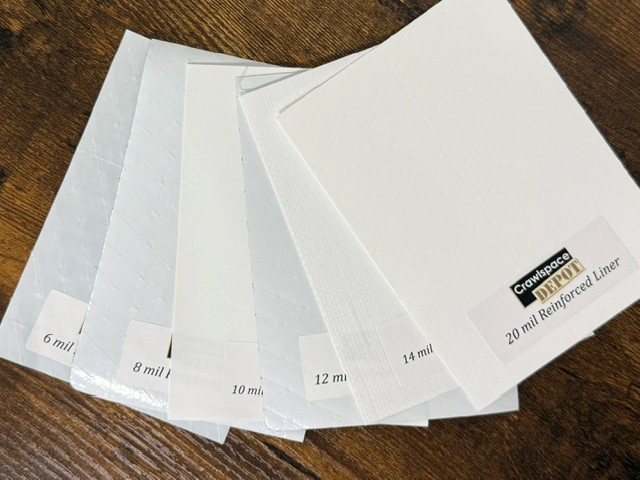
Choosing a crawl space vapor barrier thickness is one of the first decisions in an encapsulation project. The goal is simple: cover the ground, block ground moisture, and create a durable surface that will hold up after installation.
The right thickness depends on the crawl space. A smooth, low traffic crawl space does not need the same material as a rocky crawl space with regular service access. Mil thickness matters, but it is not the only factor. Reinforcement, ground condition, installation quality, and how often someone will enter the crawl space all matter too.
Short Answer
For most crawl space encapsulation projects, avoid thin consumer plastic and choose a vapor barrier based on durability needs.
- 6 mil: Better suited for temporary or light duty use, not the preferred choice for a lasting crawl space encapsulation project.
- 10 mil vapor barrier options: A practical option when the ground is smooth and traffic is minimal.
- 12 mil reinforced vapor barrier: A popular and solid choice for many DIY crawl space vapor barrier projects.
- 14 mil woven coated vapor barrier: A stronger option when you want more durability without jumping to a much heavier material.
- 20 mil reinforced vapor barrier: A heavy duty option for rough ground, higher traffic, or premium installations.
If you are not sure where to start, browse Crawlspace Depot's crawl space vapor barriers and compare the thickness, reinforcement, roll size, and installation needs.
Want a more detailed breakdown? Read the Crawl Space Vapor Barrier Buying Guide to learn more about liner differences, roll sizes, reinforcement, and how to choose the right vapor barrier for your crawl space.
What Does Mil Mean?
A mil is one thousandth of an inch. A 10 mil vapor barrier is 0.010 inches thick. A 12 mil vapor barrier is 0.012 inches thick.
That sounds small, but the difference can be noticeable in a crawl space. Thicker material usually resists punctures and wear better. It can also feel easier to handle when you are crawling across the surface after installation.
Still, thickness is only part of the decision. A reinforced vapor barrier can be stronger than a non reinforced product of similar thickness because the reinforcement helps resist tearing.
Crawl Space Vapor Barrier Thickness Comparison
| Thickness | Best For | Main Advantage | Main Limitation |
|---|---|---|---|
| 6 mil | Temporary coverage, light duty use, vented or sacrificial applications | Easy to handle for temporary or light duty coverage | Not the preferred choice for a durable encapsulation project |
| 10 mil | Smooth ground, low traffic crawl spaces | Better durability than thin plastic while still easy to handle | Less protection on rocky soil or frequent access paths |
| 12 mil | Typical DIY encapsulation projects | Strong balance of durability, handling, and value | May not be enough for very rough ground or heavy service traffic |
| 14 mil | More demanding crawl spaces, stronger long term coverage | Added strength and puncture resistance | Heavier than lighter options |
| 20 mil | Rough ground, contractor grade work, premium durability | Maximum durability in the common crawl space range | Heavier to move, cut, and install |
Is 6 Mil Plastic Thick Enough for a Crawl Space Vapor Barrier?
6 mil vapor barrier options are available for certain light duty uses, and six mil plastic is also common at hardware stores, but it is usually not the best choice for a crawl space encapsulation project. It can tear more easily, puncture on rough ground, and wear down faster if anyone needs to crawl over it for service access.
That does not mean 6 mil material has no use. It can work for temporary coverage or light duty situations. For a crawl space you expect to seal and rely on for years, it is usually better to step up to a thicker, more durable vapor barrier.
Is 10 Mil Vapor Barrier Worth It?
A 10 mil vapor barrier can make sense when the crawl space has smooth ground and limited traffic. It is a strong choice compared with thin plastic and can work well when installed carefully.
The main question is how much wear the vapor barrier will see. If the crawl space has rocks, roots, debris, low clearance, or equipment that needs regular service, moving up to a reinforced 12 mil, 14 mil, or heavier product may be the better long term decision.
What Is the Difference Between 10 Mil and 12 Mil Vapor Barrier?
The difference is durability. A 12 mil reinforced vapor barrier gives you more material thickness than 10 mil, which can help with puncture resistance and wear. It is often a solid choice for DIY homeowners because it is still manageable to install but gives more protection than lighter material.
For a clean, smooth crawl space with little traffic, 10 mil may be enough. For a typical encapsulated crawl space where someone may need to access plumbing, HVAC, or wiring later, 12 mil is often the safer choice.
When Should You Use Reinforced Vapor Barrier?
Use reinforced vapor barrier when durability matters. Reinforcement helps the material resist tearing and pulling apart, especially around seams, corners, and areas where installers or service technicians crawl.
Reinforced material is especially useful when:
- The crawl space has rough or uneven ground
- Someone will enter the crawl space for maintenance
- HVAC equipment, plumbing, or sump equipment is present
- You want the vapor barrier to hold up better over time
- The crawl space is part of a full encapsulation project
Mil thickness tells you how thick the plastic is. Reinforcement tells you more about how well the product may resist damage during real use.
Best Thickness by Crawl Space Scenario
Smooth or Low Traffic Crawl Space
If the crawl space is smooth, dry, and rarely entered, 10 mil can be a reasonable choice. The installation still matters. Seams need to be overlapped and sealed, the material should run up foundation walls where appropriate, and the crawl space should be checked after installation.
Typical DIY Encapsulated Crawl Space
For many DIY projects, 12 mil reinforced vapor barrier is a strong choice. It offers a practical balance of durability and handling. It is not the only good answer, but it is popular because it fits the needs of many crawl spaces without being overly heavy.
Rough Ground or Frequent Access
If the crawl space has rocks, uneven soil, sharp debris, or frequent service traffic, consider 14 mil woven coated vapor barrier or heavier. A thicker reinforced product gives you more protection where the vapor barrier is most likely to be damaged.
Premium or Heavy Duty Installation
A 20 mil reinforced vapor barrier is worth considering when durability is the top priority. It is heavier and can take more effort to install, but it provides added protection for rough conditions, contractor grade installations, and crawl spaces where equipment access is common.
Should Crawl Space Walls and Floors Use the Same Thickness?
Not always. The floor usually takes more abuse because people crawl on it, tools sit on it, and it covers rough ground. The walls usually do not see the same level of traffic.
Some projects use heavier material on the floor and a lighter material on the walls. Others use the same product throughout for simplicity. Either approach can work if the seams are sealed, the material is secured properly, and the crawl space is detailed well around piers, corners, and penetrations.
Does Thicker Vapor Barrier Stop More Moisture?
In a lab setting, a thicker vapor barrier can technically stop more moisture through the liner itself, as thicker liners typically have lower permeability than thinner liners.
However, the difference between 0.022 perms and 0.026 perms would be nearly impossible to notice in the real world. Vapor barrier thickness alone will not be the differentiating factor in the success of your installation. Seams, edges, penetrations, drainage, bulk water, and humidity have a much bigger effect on crawl space conditions than small permeability differences between liner thicknesses.
A vapor barrier blocks ground moisture. It does not remove humidity from the air, fix standing water, or replace a dehumidifier when the crawl space needs active humidity control.
Final Recommendation
For a long lasting crawl space encapsulation project, choose the vapor barrier thickness based on how the crawl space will be used.
If the ground is smooth and traffic is low, 10 mil may be enough. For many DIY homeowners, 12 mil reinforced is a popular and solid choice. If the crawl space is rough, tight, or frequently accessed, 14 mil or 20 mil may be worth the upgrade.
The best crawl space vapor barrier is not just the thickest product. It is the product that fits the crawl space conditions, installs cleanly, and stays sealed over time.
FAQ
What mil vapor barrier should I use in a crawl space?
Most lasting crawl space encapsulation projects should use 10 mil or thicker material. Many homeowners choose 12 mil reinforced as a popular and solid choice. Rough or high traffic crawl spaces may justify 14 mil or 20 mil.
Can I use plastic sheeting from a hardware store in a crawl space?
You can, but thin consumer plastic is not usually the best choice for encapsulation. It can tear, puncture, and wear faster than crawl space vapor barrier products designed for long term use.
What thickness is best for an encapsulated crawl space?
There is no single best thickness for every crawl space. For many encapsulated crawl spaces, 12 mil reinforced is a practical choice. Move heavier if the ground is rough, traffic is frequent, or durability is the top priority.
Do I need 20 mil vapor barrier in a crawl space?
Not always. A 20 mil vapor barrier is useful for rough ground, premium installations, and crawl spaces with frequent access. Many smoother, lower traffic crawl spaces can perform well with 10 mil, 12 mil, or 14 mil when installed correctly.