
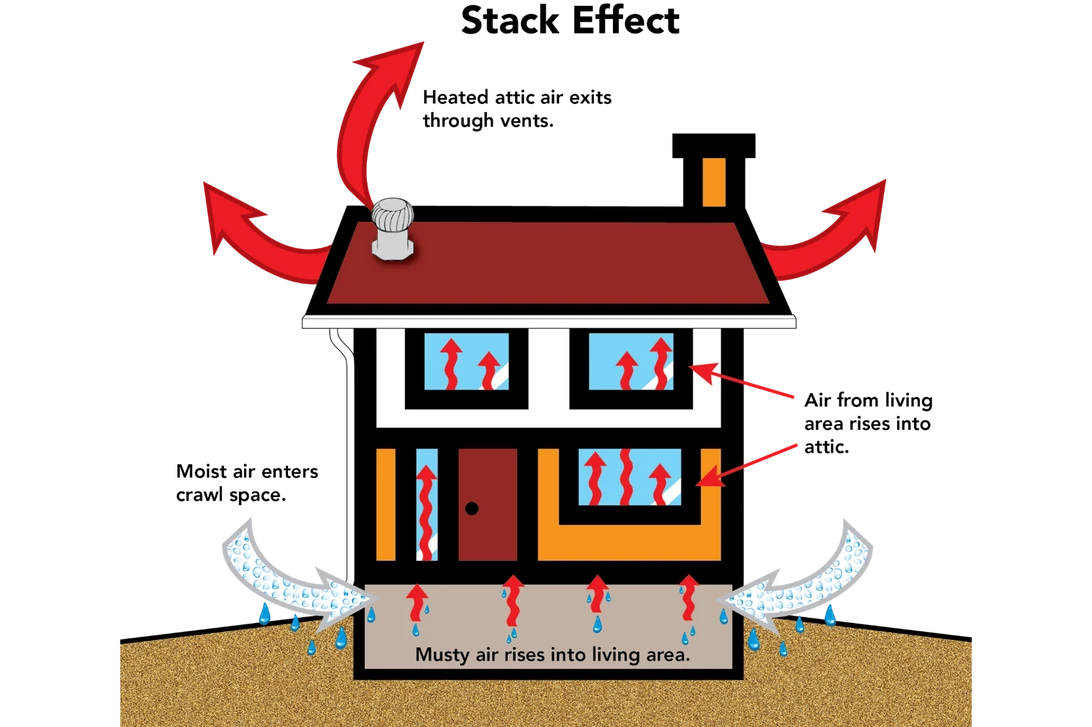
If your home has a musty smell you can't track down, floors that feel cold in winter, or humidity that seems worse than the outside air, stack effect may be part of the cause. It is one of the more overlooked forces affecting crawl space moisture problems, and understanding it is the first step toward fixing the problem for good.
What Is Stack Effect?
Stack effect is the movement of air through a building caused by differences in air pressure between the inside and outside. Warm air is less dense than cold air, so it rises. In a house, this means warm indoor air naturally moves upward and eventually escapes through openings at the top of the building: around windows, through attic vents, through gaps in the ceiling.
As that air escapes, it has to be replaced. The replacement air gets pulled in through gaps and penetrations throughout the structure: leaky windows, doors, and openings wherever air can find a path. The crawl space is a major source of that incoming air, because the foundation and floor system typically have many unsealed openings around pipes, wiring, and framing.
Think of your house as a slow, continuous chimney. Air rises and exits near the top, and the crawl space is one of the primary intake points at the bottom.
How Stack Effect Works in Your Home
The intensity and direction of stack effect changes with the seasons.
In winter:
- Warm air inside the home rises and escapes through the upper portions of the house.
- Colder, drier outside air gets pulled in through the crawl space to replace it.
- If the crawl space has open foundation vents or gaps in the rim joist, outside air flows directly into the crawl space and then rises into the living area.
- The result is cold floors, drafts near the floor, and higher heating bills as conditioned air leaks out the top while cold air comes in the bottom.
In summer:
- Hot air in the attic and upper parts of the house continues to rise and escape, just as it does in winter.
- That loss of air at the top still draws outside air in through the bottom of the house, including through the crawl space.
- In summer, the air being drawn in is warm and humid rather than cold and dry.
- The crawl space becomes a direct delivery system for outdoor humidity into your living space.
- Crawl space humidity problems are often worst in summer for this reason.
In both cases, the crawl space is at the center of the problem. It sits at the bottom of the stack. That is the point where outside air enters the system.
Signs You Have a Stack Effect Problem
You may not know what stack effect is, but you have probably felt the effects. Common signs include:
- Musty smell in the home: The odor tends to be strongest in rooms above the crawl space or near the floor, because crawl space air feeds directly into the living area.
- Cold floors in winter: Cold air pooling low in the home is a sign that outside air is entering through the bottom of the structure.
- High humidity indoors: This is particularly noticeable in summer, when outdoor humidity is high and crawl space vents let it in freely.
- Higher energy bills: The home is constantly losing heated or cooled air at the top while pulling in unconditioned outside air at the bottom.
- Humidity that seems worse than outside: This can happen when humid crawl space air mixes with cooler indoor air, raising the relative humidity in the living area.
- Condensation on surfaces in the crawl space: Pipes, ductwork, or wood framing showing moisture are a sign the crawl space is too humid. Stack effect can contribute by drawing more outside air through the crawl space, but it is not the only cause.
If any of these sound familiar, the crawl space is likely part of the cause.
Why Crawl Spaces Make Stack Effect Worse
An open or vented crawl space is essentially a direct intake for outside air. Foundation vents, gaps around pipes and utility penetrations, and cracks in the rim joist are all pathways that let outside air feed the stack.
Once air enters the crawl space, it does not stay there. The framing above the crawl space is rarely airtight. Air moves up through gaps around ductwork, pipes, wiring, and subfloor seams. The living area above gets a continuous supply of whatever air quality exists in the crawl space.
If the crawl space is damp, the house will feel damp. If the crawl space smells musty from mold or degraded wood, that smell comes with it. The ground itself releases moisture vapor year-round. In an open crawl space, that vapor has nowhere to go but up.
This is why crawl space moisture control is not just about the crawl space. It is about the entire house.
How to Stop Stack Effect in a Crawl Space
You cannot eliminate air pressure differences. They are a basic fact of physics. But you can interrupt the pathway that lets outdoor air enter your home through the crawl space. The approach that works is crawl space encapsulation.
Encapsulation seals the crawl space from outside air and ground moisture. A quality vapor barrier, 8 mil or heavier, covers the ground and is sealed to the foundation walls. Foundation vents are closed and sealed. Penetrations in the rim joist, foundation, and floor system are sealed with spray foam or rigid foam insulation.
When the crawl space is sealed, outdoor air can no longer enter freely through the bottom of the stack. That stops the primary intake point for stack effect in its tracks.
A dehumidifier handles the residual moisture that still enters through minor infiltration and through the concrete itself. An encapsulated crawl space gives a dehumidifier the right environment to work: a small, sealed space where it can efficiently maintain a target humidity level rather than fighting an open exchange with outdoor air.
Together, a sealed crawl space with a quality vapor barrier and a properly sized dehumidifier address the stack effect problem at the source rather than treating symptoms room by room.
If you want to understand where to start, the crawl space encapsulation section of the site walks through the full system. A humidity monitor installed in the crawl space will also give you a baseline reading so you know what you are actually dealing with before spending money on solutions.
Frequently Asked Questions
Is stack effect good or bad?
Stack effect is a natural physical process that happens in every building. Whether it causes problems depends on how well the building is sealed. In a home with an open or vented crawl space, stack effect continuously pulls outside air in through the bottom of the house. That makes crawl space moisture control much harder and can lead to humidity, musty odors, and higher energy costs. A sealed crawl space removes the easy intake point.
Does stack effect happen in summer too?
Yes. Hot air in the attic and upper parts of the house rises and escapes year-round, including in summer. That air movement still creates the same pressure difference that draws outside air in through the crawl space. In summer, that incoming air is warm and humid rather than cold and dry, which is why crawl space moisture problems are often most noticeable in warmer months. The driving mechanism is the same as in winter. What changes is the quality of the air being drawn in.
How do you fix stack effect in a house?
The most effective solution for most homes is to seal the crawl space. This means installing a vapor barrier on the ground and walls, sealing foundation vents, closing penetrations around pipes and wiring, and adding a dehumidifier sized for the crawl space. Once the crawl space is no longer acting as an open air intake, the stack effect pathway through the home is significantly reduced.
Why is my crawl space so humid even when the outside is dry?
Ground moisture is the main reason. Soil releases water vapor year-round regardless of outdoor conditions. In an open crawl space, that moisture rises directly into the crawl space with nowhere to go. Even on a dry day, the ground under your home is releasing humidity. Sealing the ground with a vapor barrier is the first step in addressing this.
Crawlspace Depot has been supplying crawl space encapsulation products to contractors and DIY homeowners since 2011. Questions about your crawl space? Browse our encapsulation products or check the Ask Mr. Crawlspace blog for more guides.